

LOWDOWN: Who needs words?
Fix your pension, drink prosecco, date the tarot

Dear readers,
Amidst all the excitement of the film screening we hosted last week at St. Bride’s Church, the LOWDOWN has slipped slightly out of its usual rotation. Don’t worry, though: we have a generous range of pieces to make up for lost time.
First up, we discuss your finances - though don’t worry, this comes with a twist. Meanwhile our tarot columnist Melissa Mercury discusses the controversial Thoth deck. And we’ve got two exhibits at the Barbican where you’ll get to delve into a multinational range of art, and into the depths of the earth itself.
Yours faithfully,
Wang Sum Luk
Deputy Editor
Pensions & Prosecco: Sip, Learn, and Sort Your Future
Pensions are important. Prosecco is enjoyable. We think learning about your future should involve more of the latter.
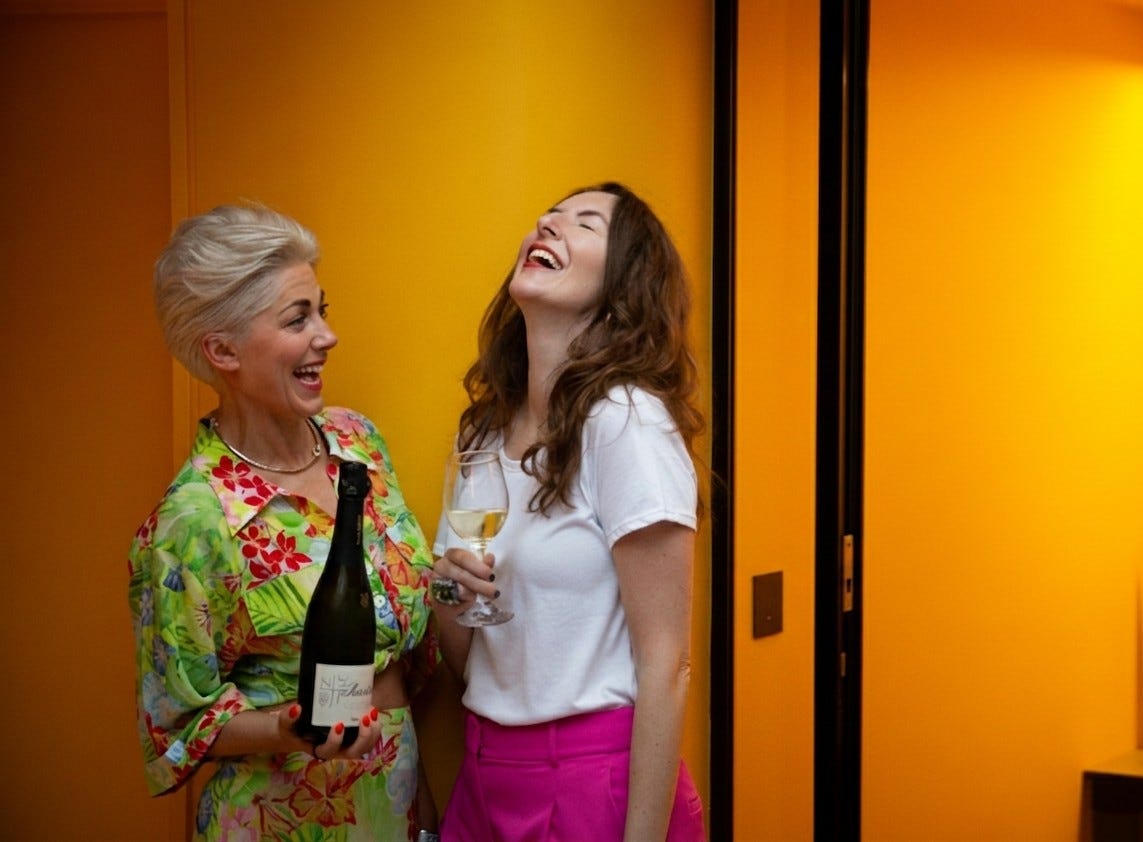
Join award-winning personal finance journalist Katie Binns and wine expert Elizabeth Hawthornthwaite for a relaxed evening of fizz, conversation and practical pension know-how.
You’ll taste three different proseccos while learning how to make sense of your pension in a clear, jargon-free way. Whether you’re freelance, employed, running a business or simply haven’t got around to sorting your pension yet, this session is designed to help you feel more confident about your financial future.
As a little taster, we’ve got 3 tips for you today. We hope they’ll whet your appetite & get you in the room for the next event on Tuesday 7th July (full details below).
The state pension age is creeping up: The state pension age is increasing from 66 to 67 by 2028 - and a further rise is expected by mid-2040s but that timeline could change. The government is reviewing whether pension ages still reflect life expectancy trends - so this isn’t fixed. Check your state pension age and use it as a planning anchor - not a surprise.
Track down lost pensions: Around 3.3 million pension schemes worth £31bn remain unclaimed or ‘lost’. Use the free, easy-to-use Pension Tracing Service to check if you’ve got one.
Your pension provider can now recommend what to do with your retirement savings: Pension firms are now allowed to give you more practical, personalised suggestions - not just generic warnings. It’s called Targeted Support. So instead of: “you might not be saving enough…” you could start seeing “here’s a more appropriate contribution level.” Instead of “there are cheaper investment options…” you could start seeing “here’s a better-value fund.” You’ll now likely start seeing more personalised nudges in apps and emails. Katie explains more here.
To join the next Pensions & Prosecco (and get a free £250 financial advice session from Kellands Chartered Financial Planners!) get your tickets below.
WHERE: Second Home, 68-80 Hanbury Street, E1 5JL
WHEN: Tuesday 7th July
WEBSITE: click here
Experimenting with empire: Donald Locke: Resistant Forms
By Molly La Fosse
The mood to visit: this summer, you’d like to feel smug by visiting an ambitious exhibition
It’s coming home—no, not the football, but the under-recognised work of Guyanese artist Donald Locke. Donald Locke: Resistant Forms, a long-overdue survey of his work, has toured Bristol and Birmingham, and come full circle to Camden Art Centre, where Locke’s work appeared in two group exhibitions in the 1970s.
Born in Guyana, in his twenties Locke received scholarships from the British Council and Guyanese government that allowed him to study art in the UK. He lived in the UK, Guyana and the US, eventually settling in Atlanta, where he made some of his most experimental works.
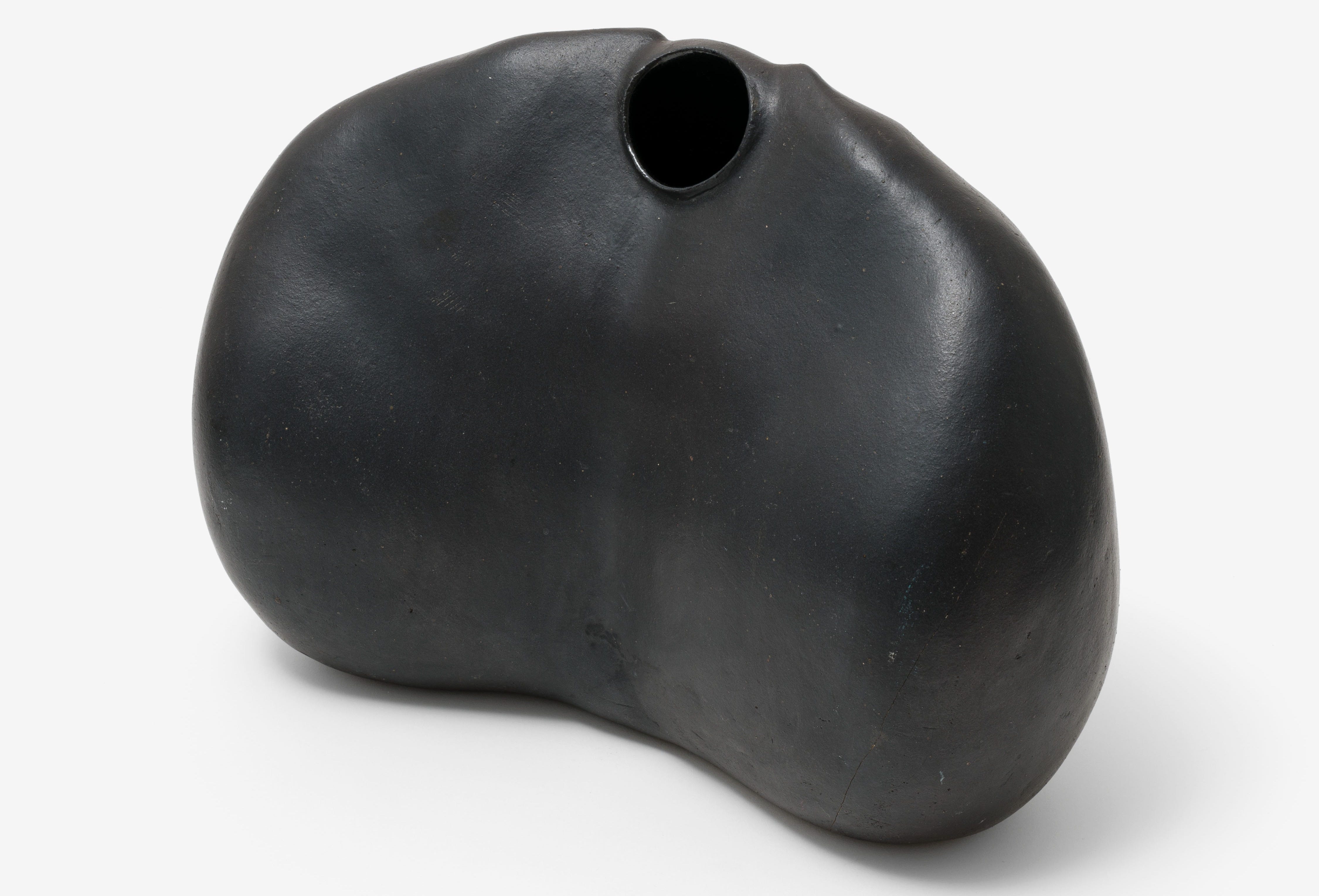
Locke’s career is remarkable for its hybridity and interdisciplinary depth, and this show offers insights into his use of mediums like ceramics, videos, installations, and mixed-media paintings. It starts with his early ceramics, smooth vessels that evoke organic forms both human and botanical—lungs, muscles, seed pods. Rejecting the conventions of mid-century British studio pottery, they hint at the subversion and experimentation that would define Locke’s output.
Take the paintings and sculptures of his Plantation series (c.1972-6). Here, black monochromatic grids are disrupted by unnerving assemblages of leather, metal and fur. Representing the subjugation and exploitation of slave plantations, it’s a striking use of formal abstraction—unexpectedly mixed with such tactile, charged materials—to represent landscapes still scarred by violent histories.
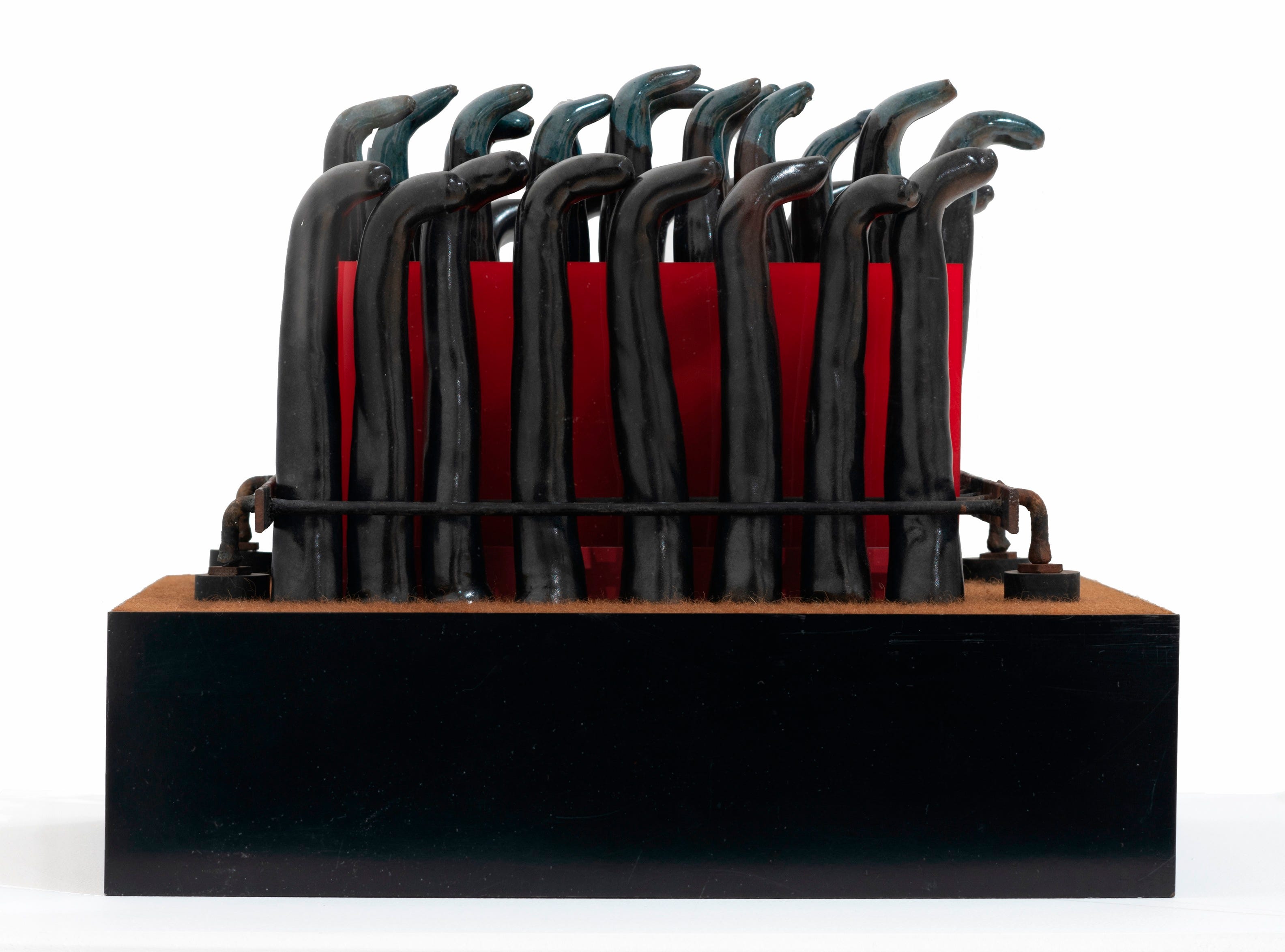
A standout work is Trophies of Empire (1972-4), a large cabinet full of dark cylindrical forms, ominous in their ambiguity and uniformity, which are mounted onto objects Locke sourced from London markets and second-hand shops. The artist maintained that these cold, menacing forms were bullets, but the phallic overtones are hard to ignore. Like so much of the work on display here, it’s rich with ambiguity but communicates a daunting sense of violence and domination, defining elements of the colonial enterprise.
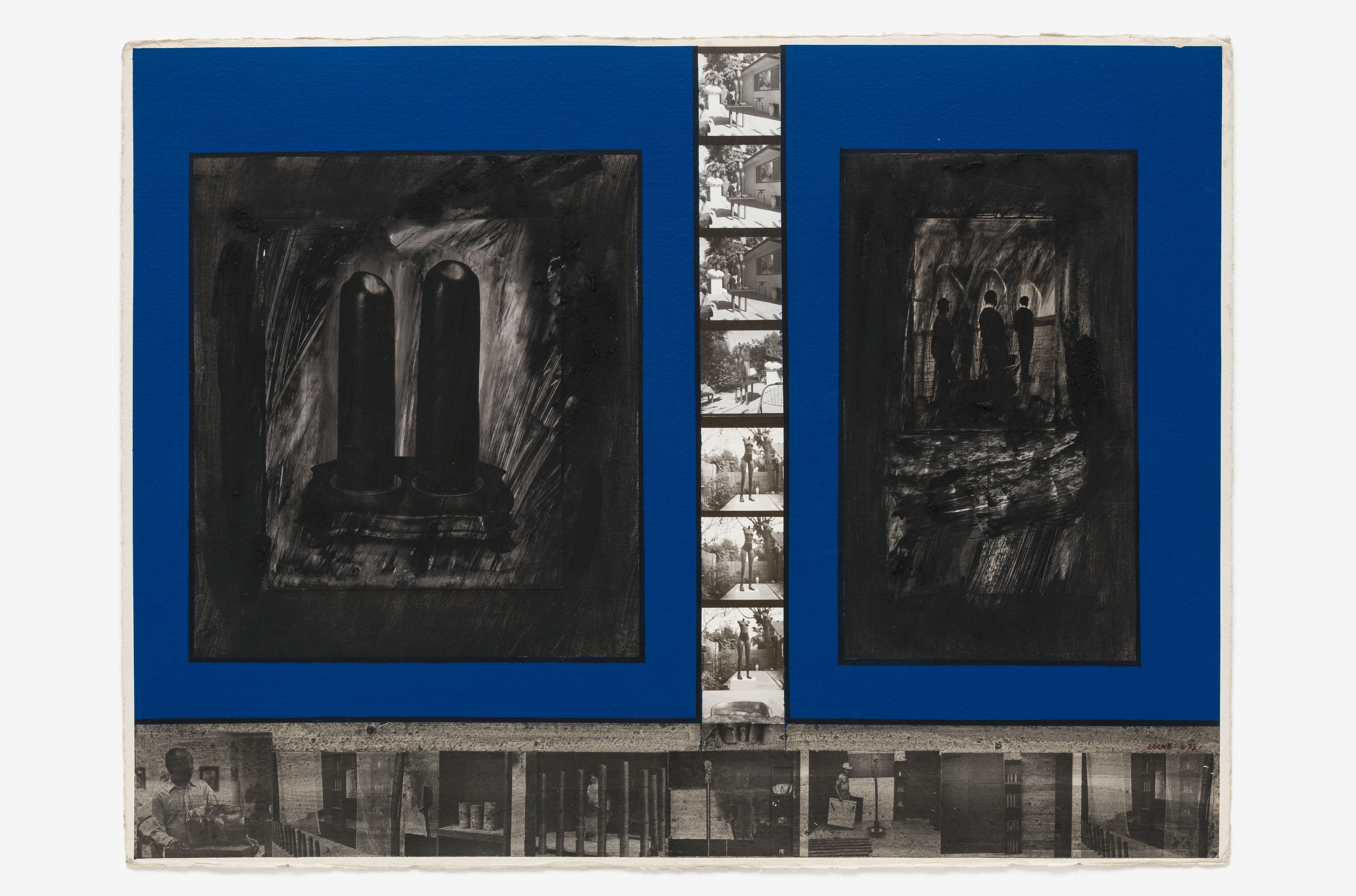
The largest room in the show is dedicated to the imposing mixed-media paintings that Locke produced in the 1990s. A charred black palette still dominates, punctured with bleeding blues and ghostly found images: of Queen Victoria, Locke’s own sculptures, Confederate flags and antebellum plantation houses. Their visceral nature speaks to the liberation the artist felt in leaving the UK for the US, escaping ‘the weight of tradition’ he experienced in Europe.
Expansive and discomfiting, this show is a testament to the ever-evolving practice of an artist who used the language of art in its many forms to confront brutal histories, probing the personal and political in the process.
WHERE: Camden Art Centre, Arkwright Rd, NW3 6DG
WHEN: Until August 30th
WEBSITE: click here
Behind the controversy of the Thoth Tarot
By Melissa Mercury
Tarot was already popular around the world by the time Aleister Crowley got involved.
A hugely controversial figure in his lifetime, Crowley was nicknamed ‘The Beast of Britain’ and ‘the wickedest man in the world’, and the infamous Thoth Tarot Deck was a collaboration between him and Lady Frieda Harris. It has a very different energy to everything that came before.
The deck incorporates mystical symbolism of the Kabbalah, science, art and more complex astrology than its predecessors. The card Strength has been replaced with Lust, Justice becomes Adjustment and Temperance becomes Art. Crowley also restructured the court cards, changing the hierarchy and making Knights take the place held by Kings.
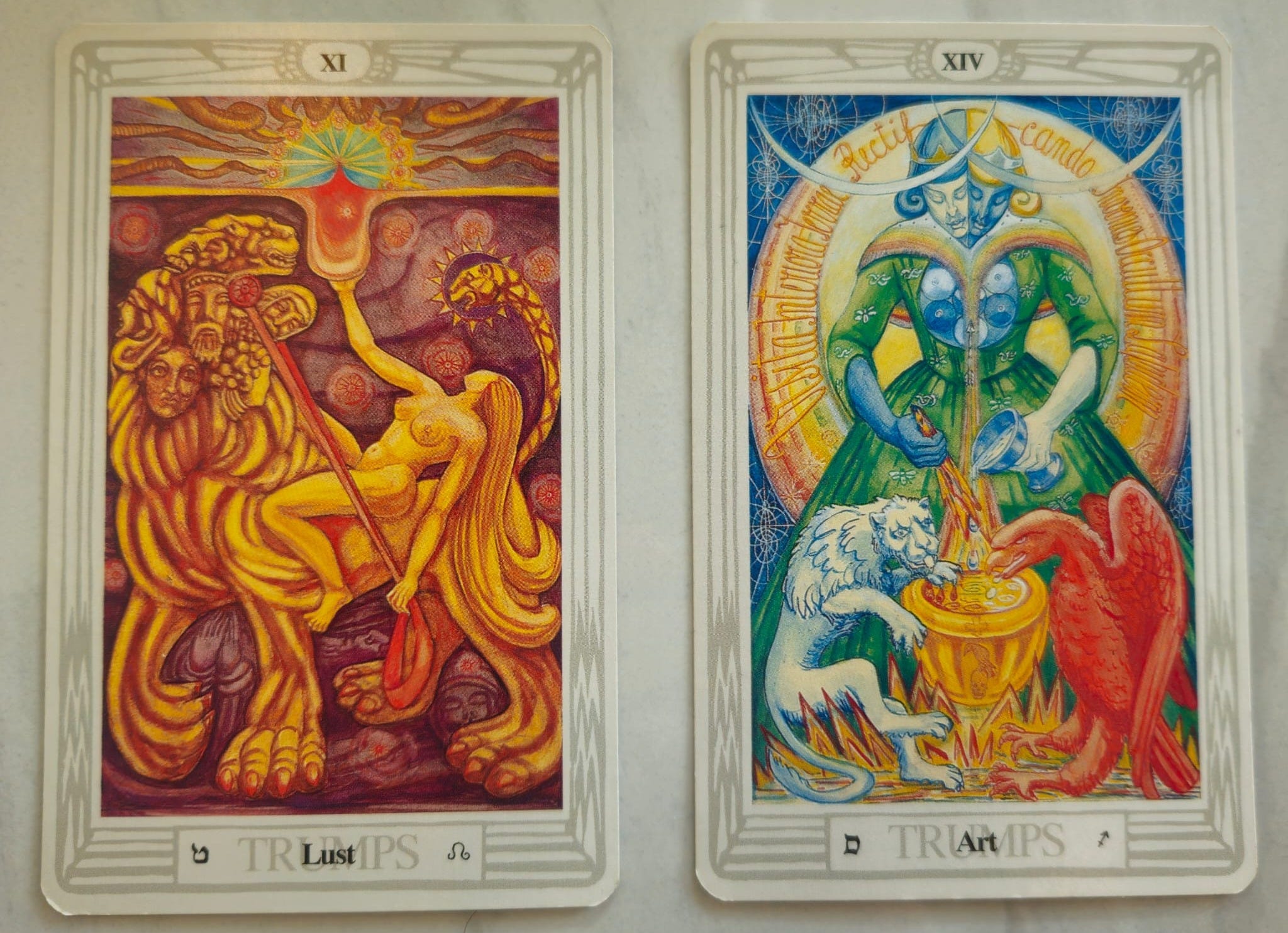
Some avoid the Thoth deck because of Crowley’s reputation for having done terrible things. However, even the fiercest critics will recognise the beauty of its Art Deco stylings, created by Lady Frieda Harris. She funded the deck and is rumoured to have come up with the concept of the collaboration. Crowley said himself - ‘She [Harris] forced me to realise each card as an individual masterpiece’
Thoth is a deck worth exploring, though it can be overwhelming at first. If you have a background in astrology, then it may complement you. In the accompanying book, Crowley gave each card its own astrological placement and key words. For example, Seven of Cups (Debauch), is, of course, Venus in Scorpio. Gemini Suns get the raw deal from this however with Ten of Swords (Ruin) representing us! I know readers who started with the Thoth as their main deck, and some who converted and never looked back.
Thoth gives a different flavour to a reading, supporting the reader with a refreshingly different perspective. The images are stark yet muted, with a greenish undertone that feels unsettling. The timing of this deck may have added to the unease. Thoth was brought to life in England between 1938 - 1943, running parallel to the Second World War.
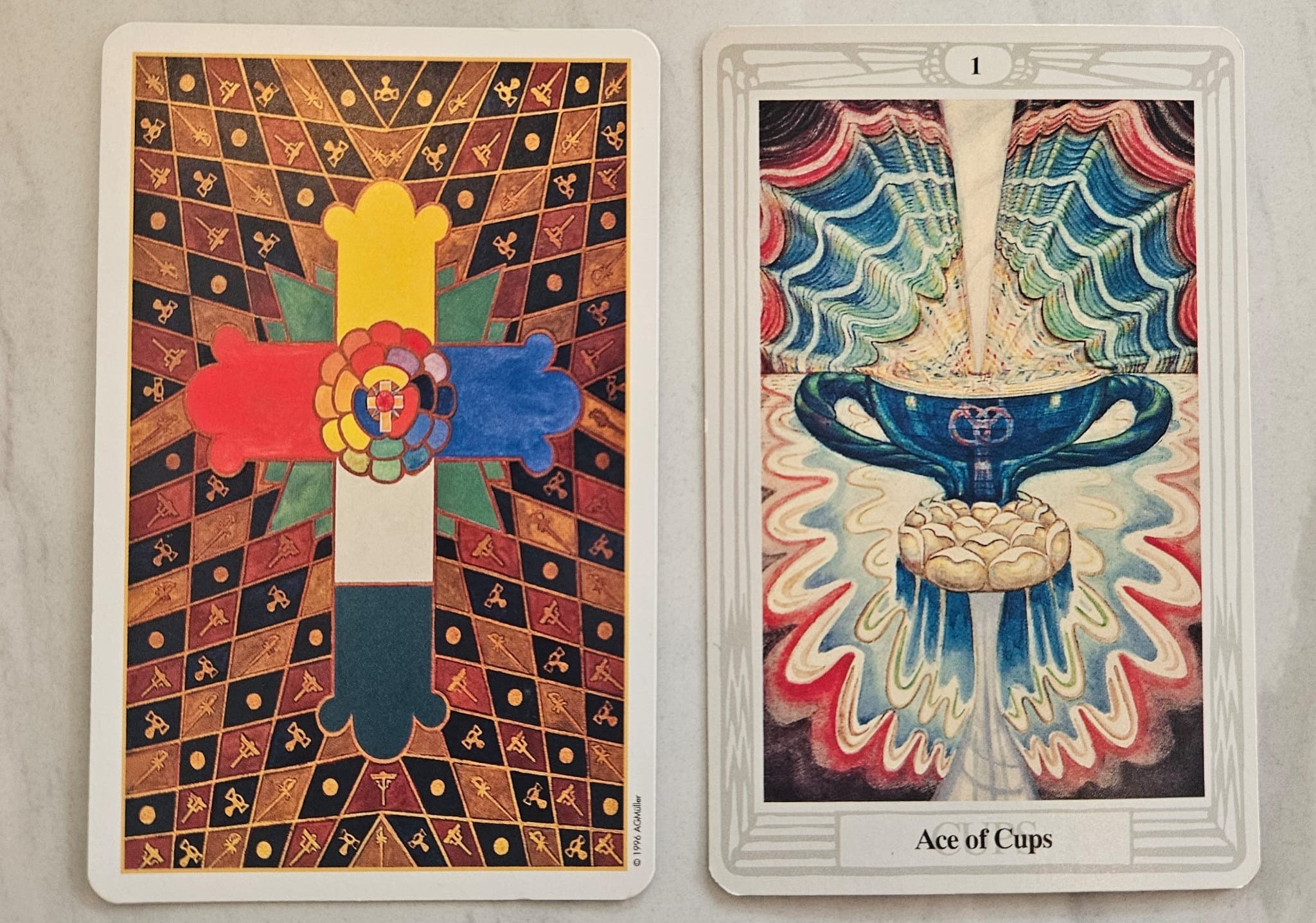
I picked up a secondhand copy of this deck and at first couldn’t work out if the wild energy was the previous owner or just the deck itself. I have come to the conclusion that it’s the deck. It has a totally different vibration, an ancient energy that I only feel drawn to if I’m in a specific, slightly unhinged, mood.
Tarot Exercise - Get to know the cards
For Crowley, one doesn’t simply just study the tarot. He declares that ‘a student cannot reach any true appreciation of the cards without observing their behaviour over a long period; he can only come to an understanding of the tarot through experience… He must live with them, they too must live with him.’
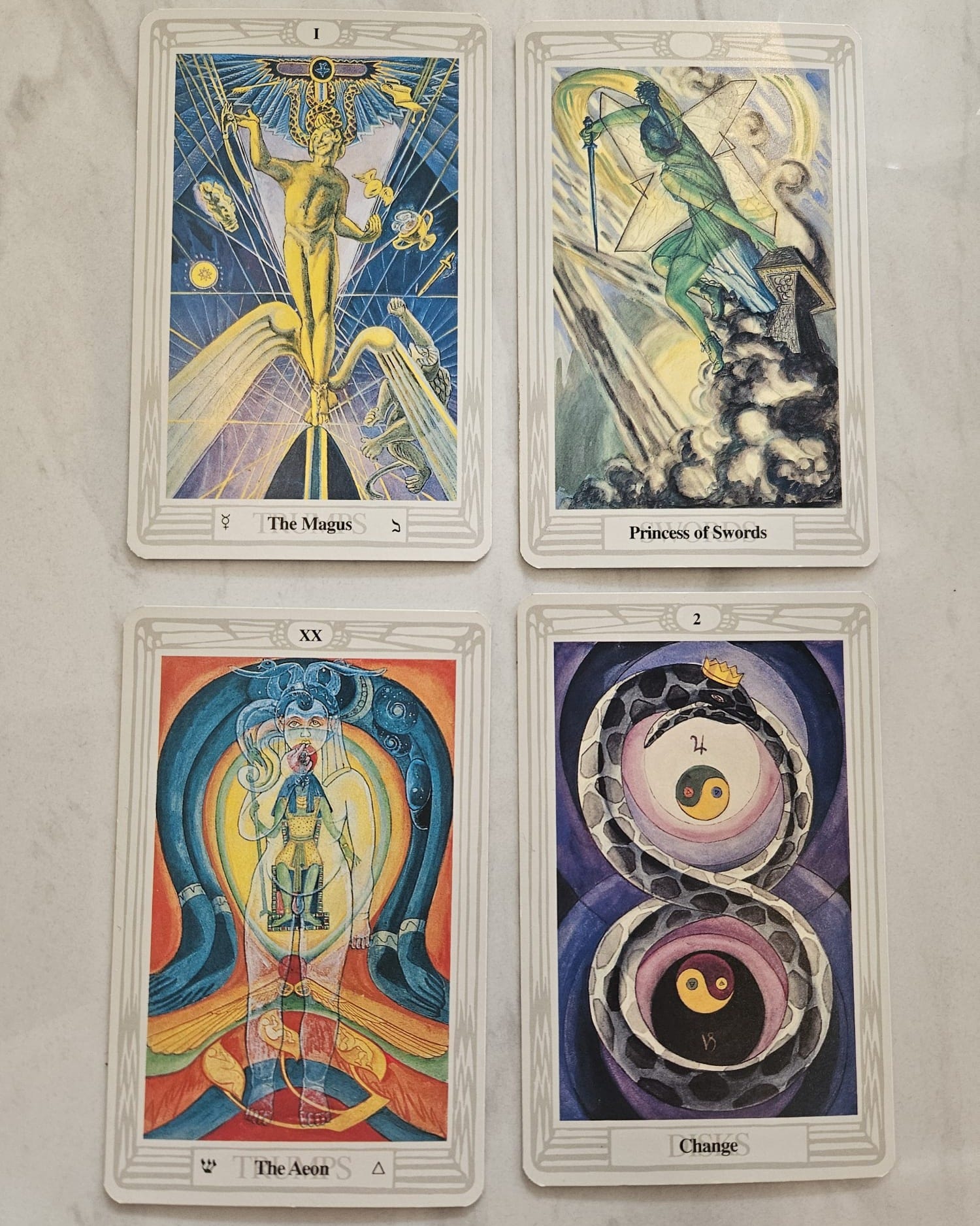
I am in agreement. I don’t just consult my cards, I date them, I hang out with them, they are my friends, my family. My challenge to you is to select either a card from the Major or Arcana or a court card and take them out for a drink. You can pick with intention or choose at random.
While out, imagine your chosen character at the venue. What are they having? Are you hanging out with the Queen of Swords, who may order a very specific martini and expect it to be perfect or will you hang out with the Knight of Wands who is ordering shots of tequila for the whole bar?
Visual versus verbal: two exhibits at the Barbican
By Wang Sum Luk
The mood to visit: can’t decide what art show to see? You’ll be spoiled for choice
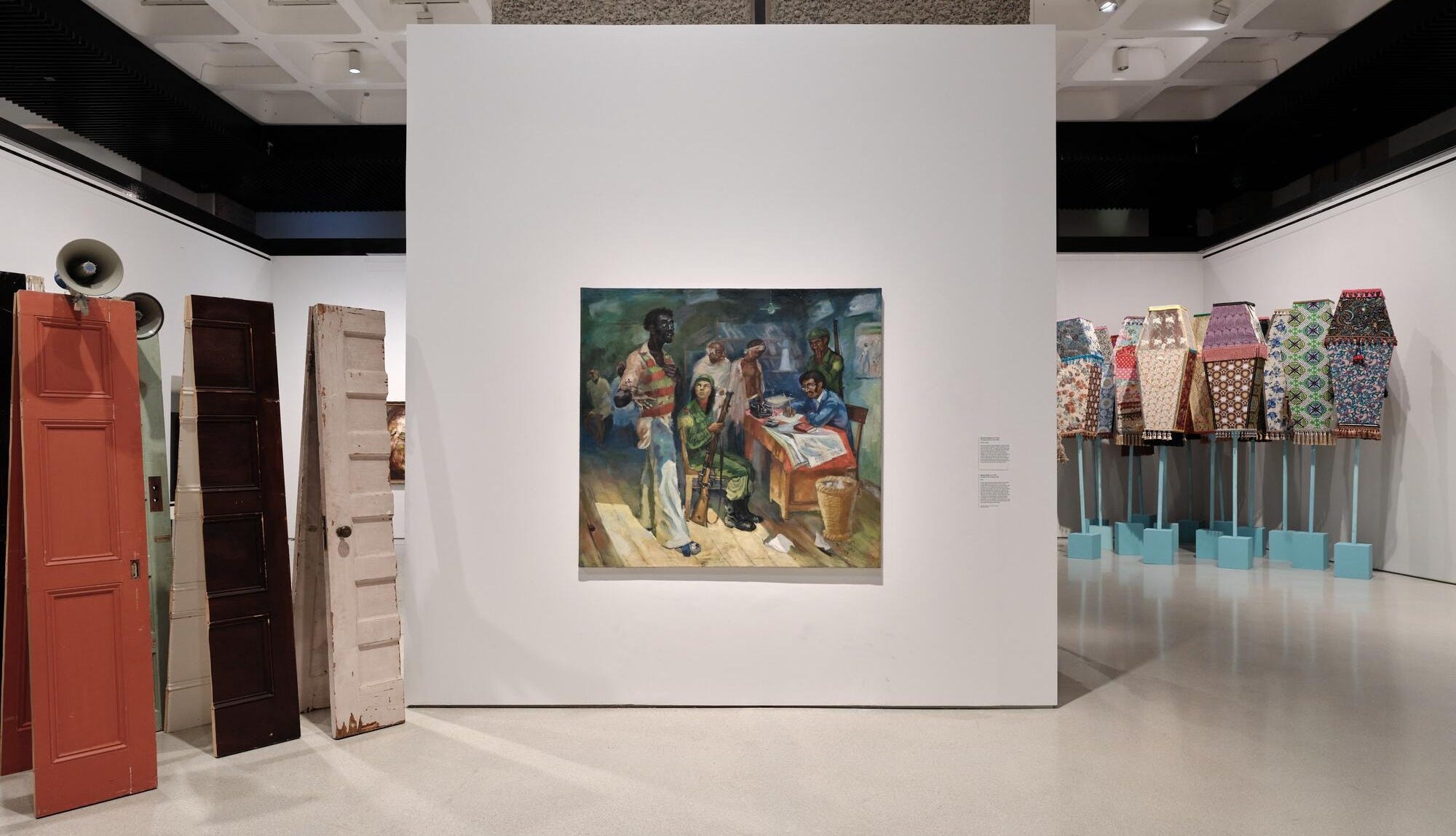
Back and forth through time, across the Americas and Caribbean and Africa—the Barbican’s latest exhibit, Project a Black Planet, is a whirlwind look at a century of art influenced by Pan-Africanism, the ideology that captivated so many of its 20th-century luminaries.
Encompassing movements promoting anti-colonialism and international solidarity across the African diaspora, Pan-Africanism takes shape here in myriad forms. There are images full of hope, like reproductions of American artist Hale Woodruff’s murals, which are magnificent odes to African history and its influence on Western culture. Others, like Ebony Patterson’s decorated coffins, inspired by the Jamaican tradition of celebratory ‘bling funerals’, deal with bleak and challenging realities.
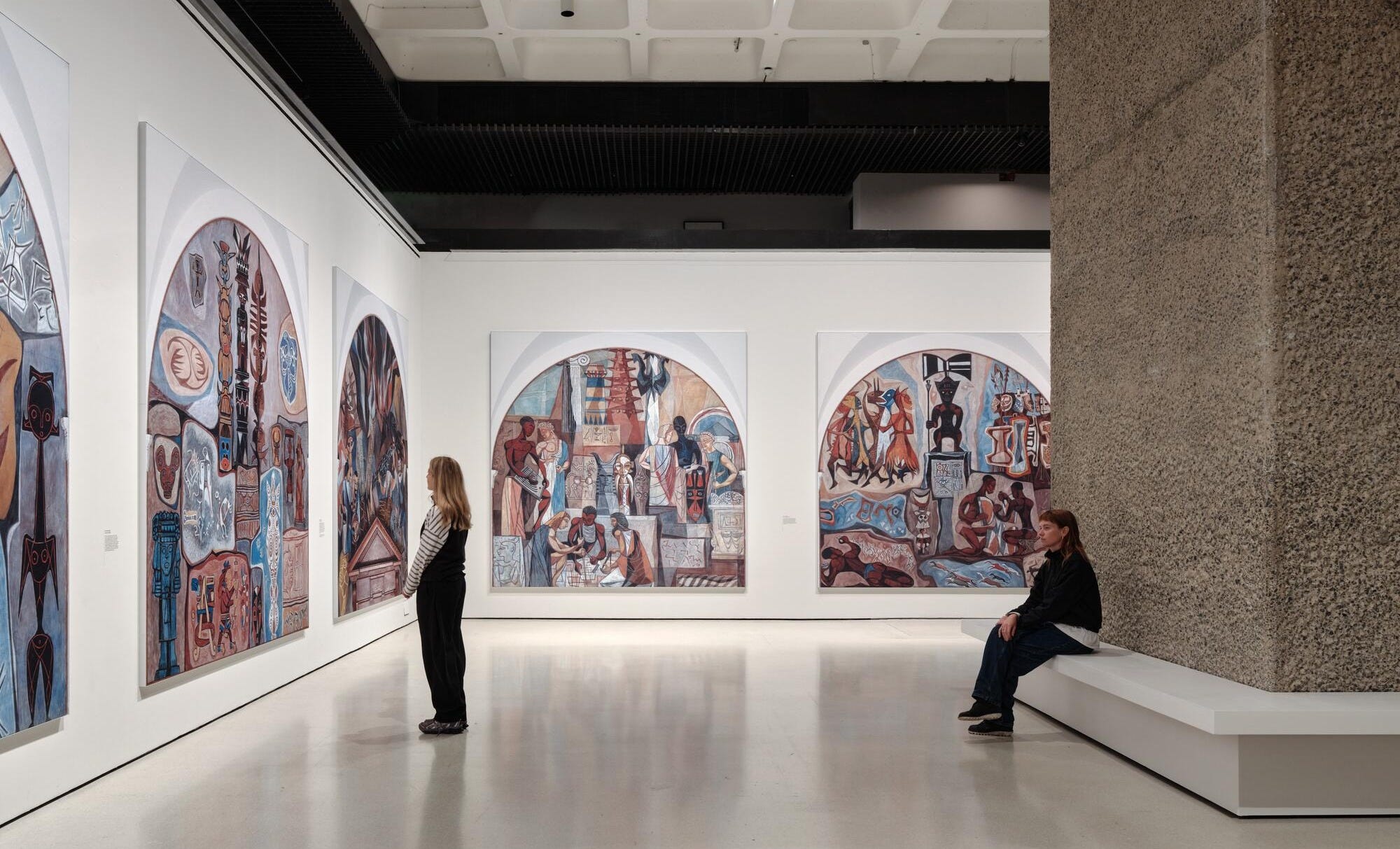
Project a Black Planet has tremendous breadth and depth, and takes the interesting approach of organising its collection thematically rather than by period or geographical region. It’s a potent way of showing the international character of this movement, though this also makes for an exhibit full of explanatory plaques burdened by jargon-heavy attempts to pack in decades of philosophical and political context. Thankfully, the artwork itself communicates powerfully enough—let them, not words on the wall, do the talking.
If you’d rather avoid dense explanatory material, you can head a little further into the Barbican’s Sculpture Court for a free exhibit that needs no words. Delcy Morelos’ installation origo (‘origin’ in Latin), a massive ring of soil and clay plunked incongruously into a Brutalist concrete estate, looks like something a UFO might leave behind if it found crop circles insufficiently avant-garde.
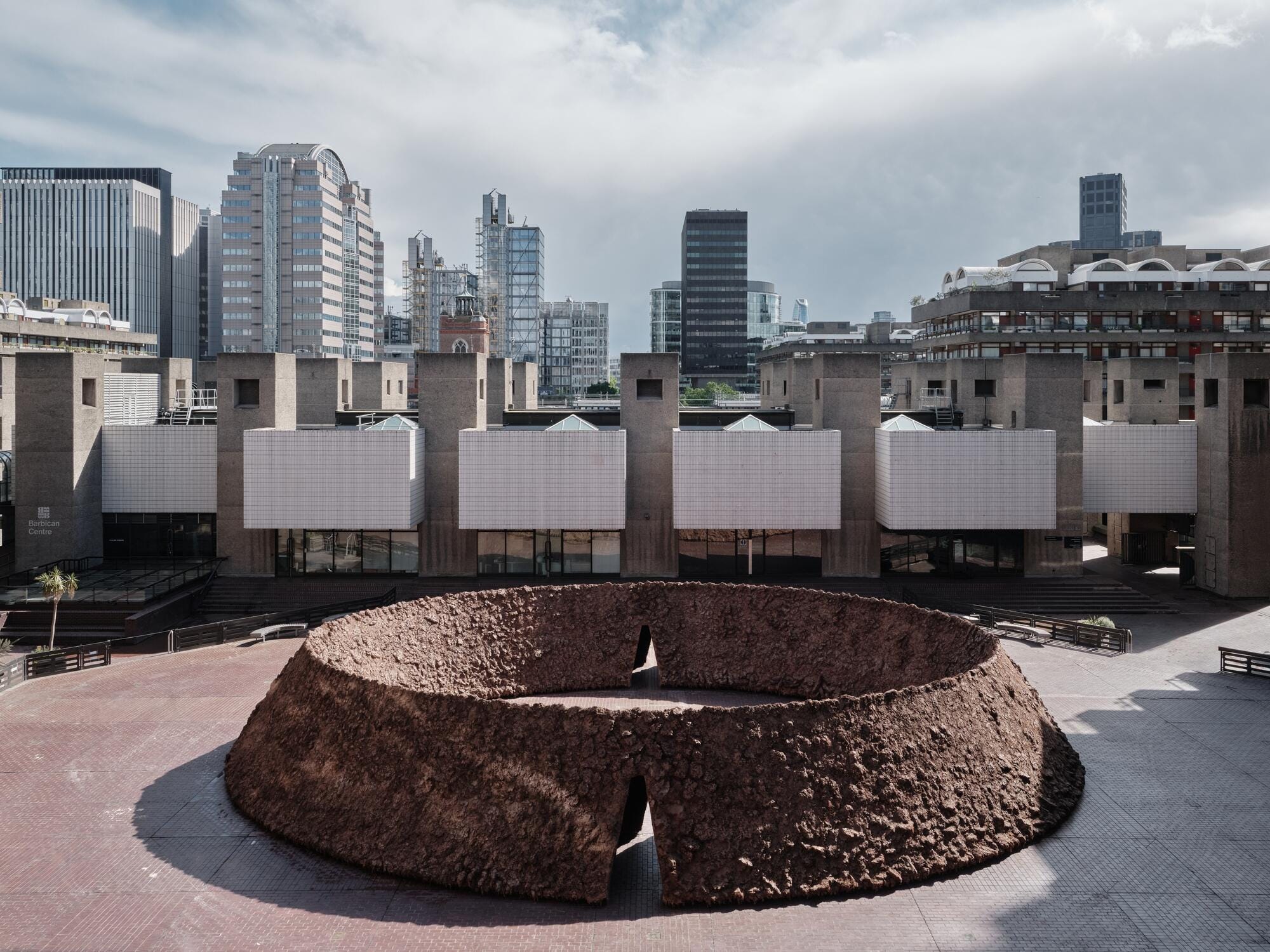
But get closer and something changes. Cinnamon and cloves have been mixed into the soil that makes up origo, and the structure has hollow tunnels within, draped with strands of plant material, that you can walk through. Step into its gloomy interior, smelling of warm spices and the ground after rain—it’s a strange, primeval moment, a glimpse of the earth’s power in the middle of a grey and technological city. From description alone, skeptics of installation art may not see much point in visiting, but origo is a multi-sensory experience. To know whether you like it, you’ll have to look (and smell) for yourself.
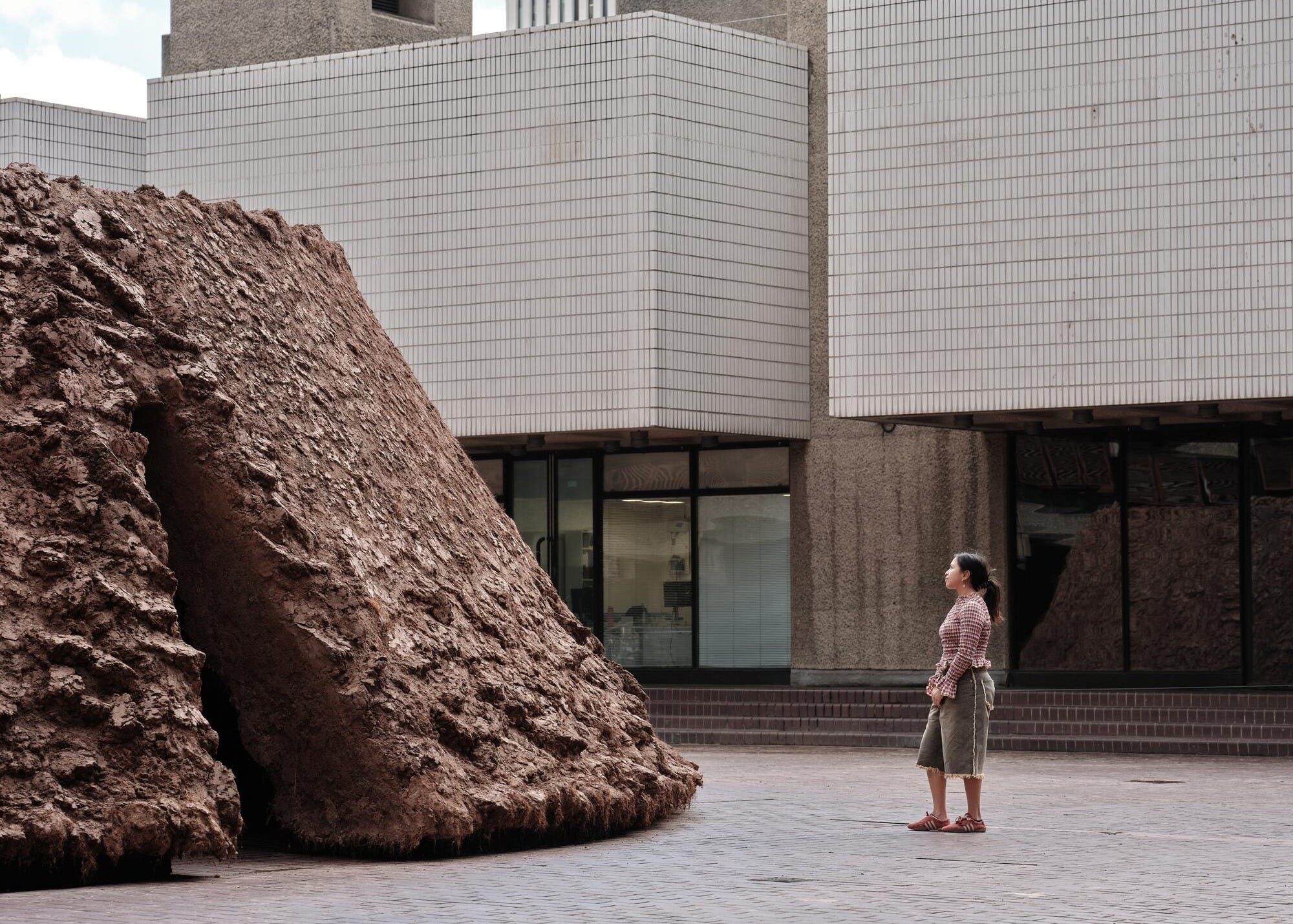
Photo credit: © Thomas Adank/Barbican Art Gallery