

LOWDOWN: control your fate!
Good things come to those who Waite

Dear readers,
We are all at the mercy of forces that no man can control—fate, karma, Tube strikes—though with luck we’ll still see plenty of you tomorrow at the film screening we’re hosting with artist Ben Edge.
If you’d like to understand some of these powerful forces better, our tarot columnist Melissa Mercury will introduce you to the history and uses of the Waite-Smith deck, whose iconic images are probably what jumps to mind when you imagine a set of tarot cards.
Perhaps they’ll help you decide whether to see the dreamy, thoughtful exhibit recommended by our gallery columnist Molly La Fosse. It closes at the end of the month, so if you do want to visit, time is of the essence!
Yours faithfully,
Wang Sum Luk
Deputy Editor
The Waite-Smith Deck: the one that changed it all
By Melissa Mercury
It’d be remiss of me to write about the history of tarot without mentioning the deck that changed it all. If you see tarot in media, it’ll probably be the Waite-Smith Deck, also called the Rider-Waite. First published in 1909, it went mainstream in the 1970s when it was printed by US Games and sold by the millions.
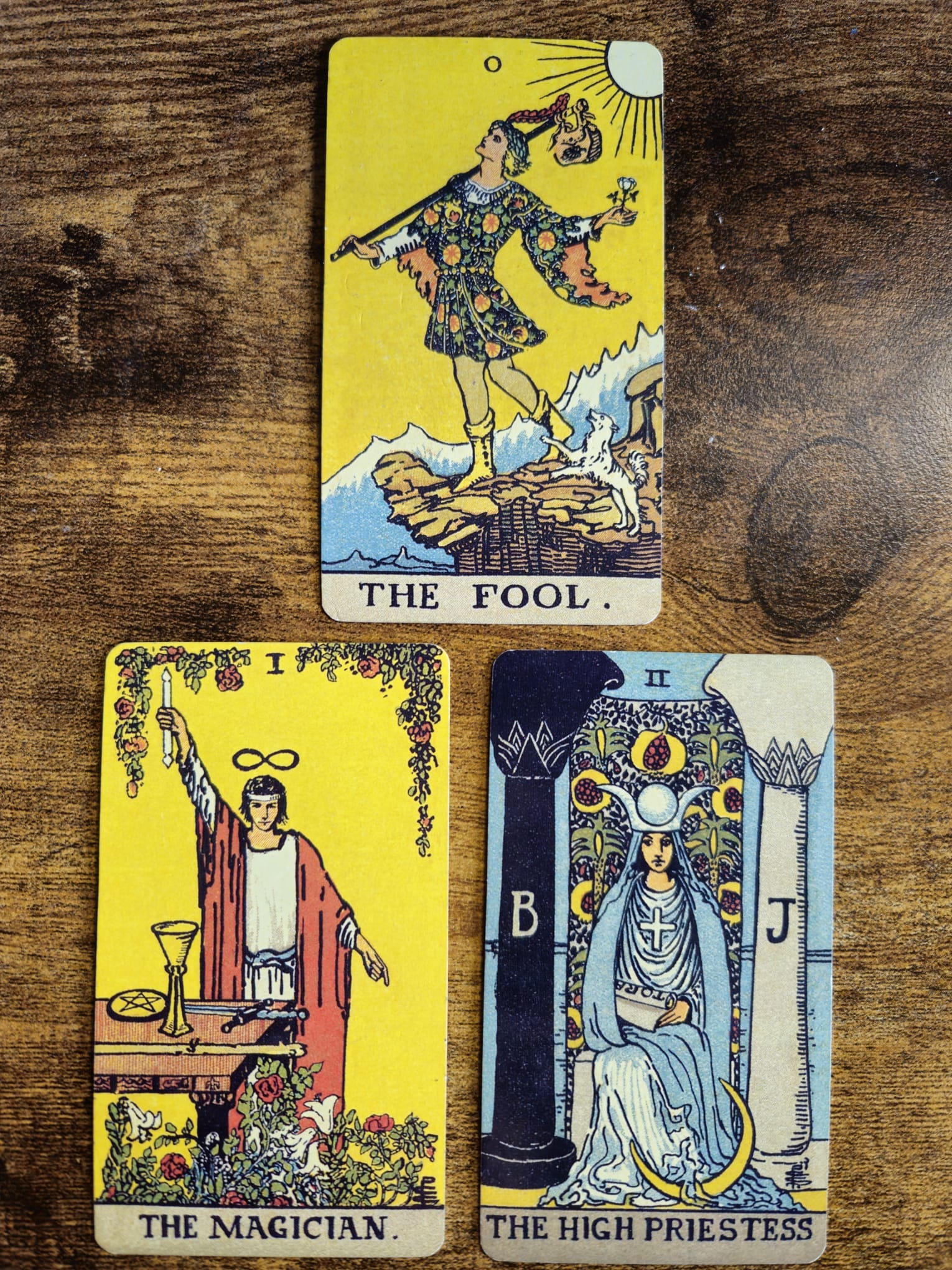
The deck was the brainchild of Arthur Edward Waite, a scholar who spent decades studying tarot, magic and the occult. The imagery that we know and love was illustrated by Pamela Colman Smith, an artist with an extraordinary resume—book illustrator, writer, suffragette and theatrical set designer—who he met through the Order of the Golden Dawn in London.
Expanding on the illustrations from the 15th-century Italian Sola Busca tarot, she took inspiration from the world around her, adding subtle references to Shakespeare, her friends, her home and even the neighbourhood cat. The Waite-Smith deck was the first to illustrate all 78 tarot cards, creating full scenes for both the Major and Minor Arcana, rather than just playing-card-like symbols of each suit.
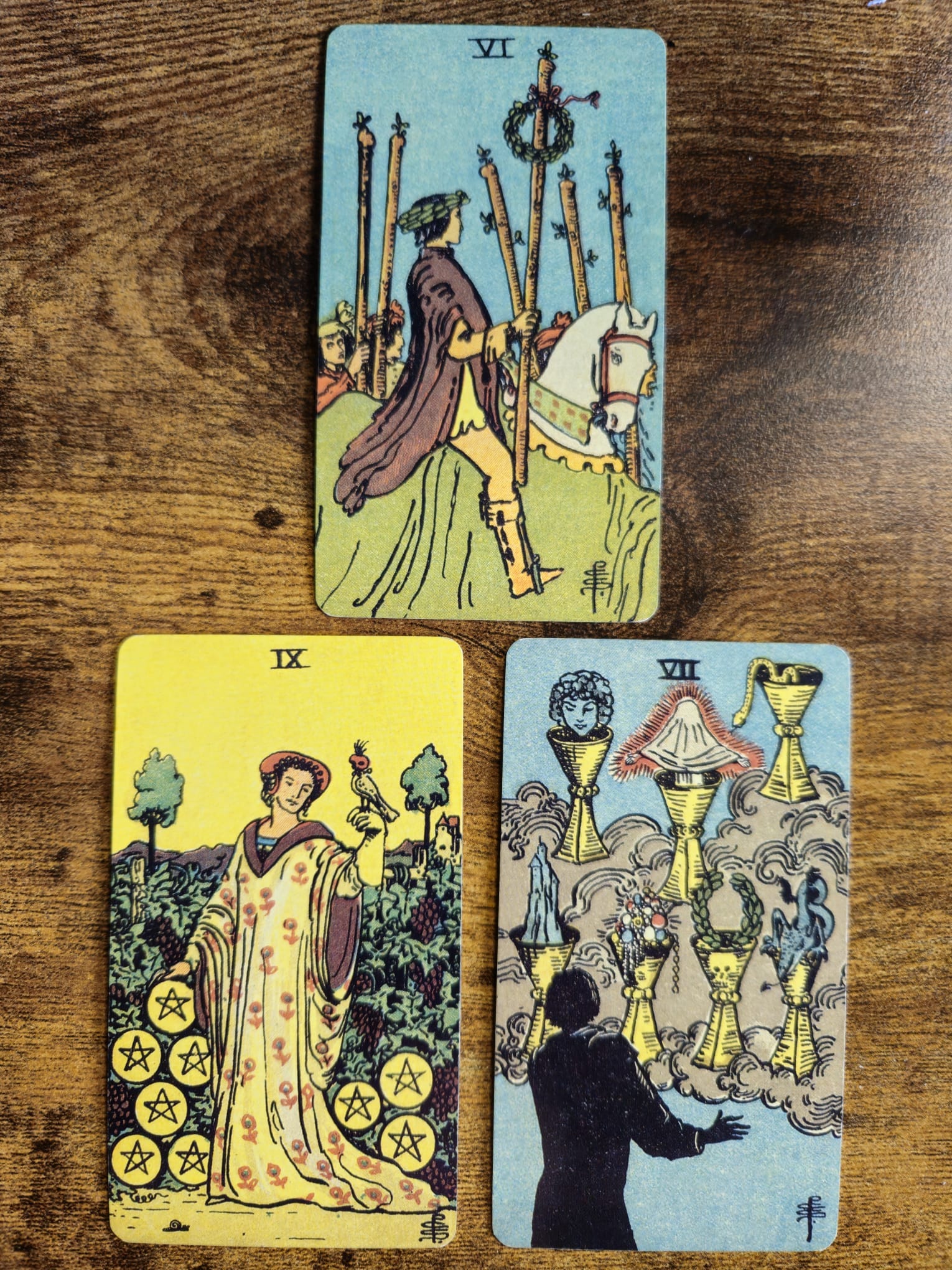
Waite’s desire to add depth to the tarot by incorporating ideas from astrology and alchemy resonated with her desire to create images packed with significance. Every colour has a significance, every flower was a deliberate choice with layers of meaning, and even the directions the characters face are another clue of how to read these mysterious cards. Next time you pick up your deck, don’t look up the meanings—work with the images, and you’ll discover a whole different way of reading.
Tarot Exercise - Perfecting the Celtic Cross Spread
Waite is credited with popularising one of the most popular tarot spreads (a term for how cards are laid out when reading), the Celtic Cross. Each placement and the interaction between them gives more context on the story unfolding.
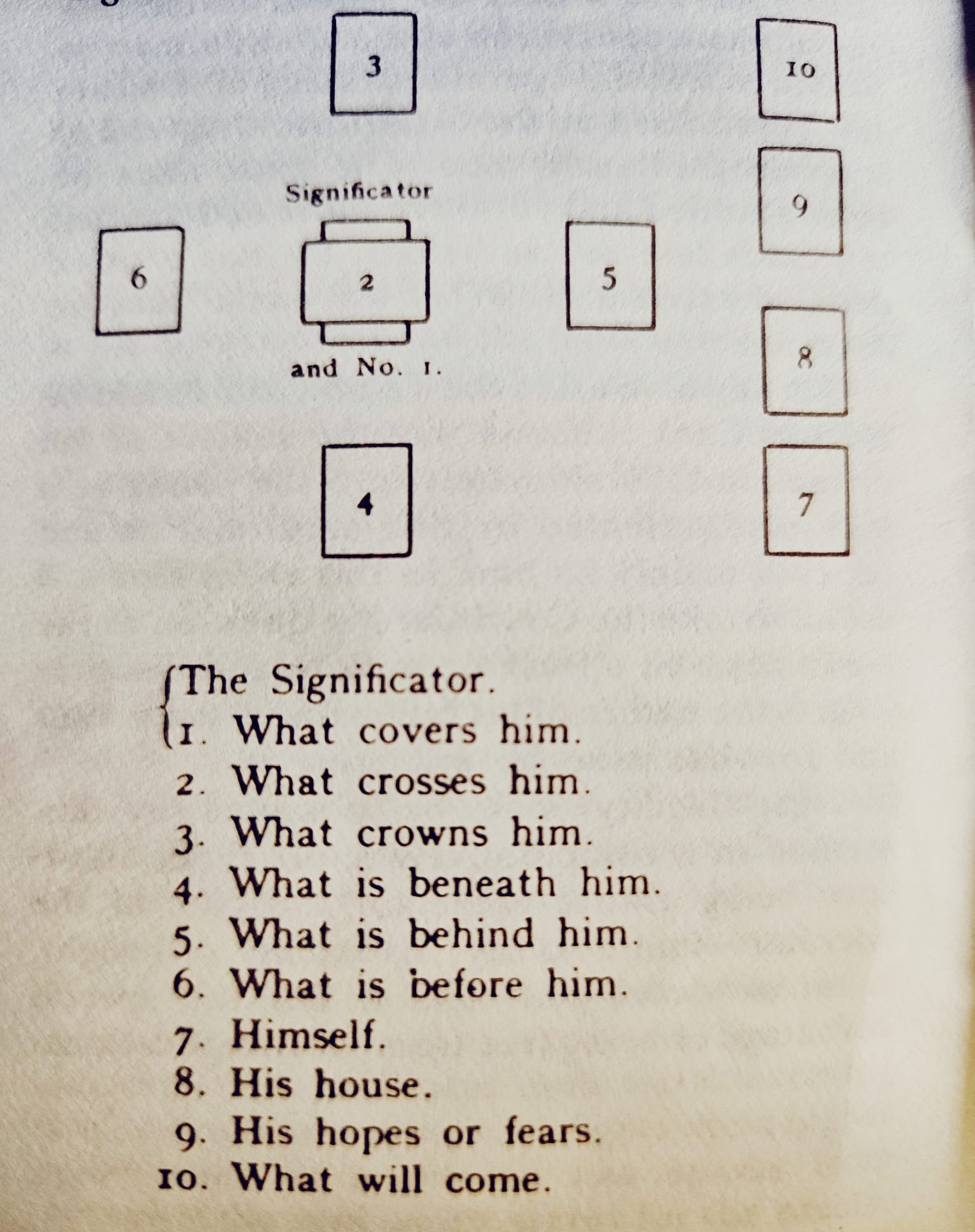
You can get a lot of information from a tarot reading of one or two cards, but if you want to get the full picture, try the Celtic Cross tarot spread, perfect for most situations. Reading using more cards also allows for you to spot patterns and see the links between actions and outcomes. This spread explores the past, present and future of a situation as well as the overall environment, thoughts, feelings, hopes and fears.
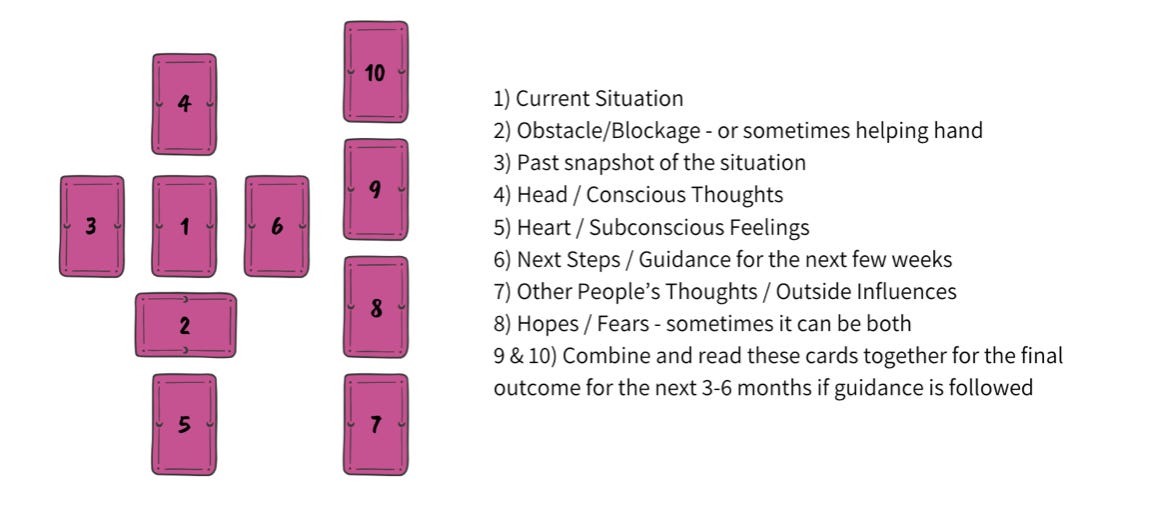
I have modified the spread to fit my own style of reading. You can always adapt techniques to best work for you: try a reading using either of these methods and see how you get on. Perhaps you’ll even be inspired to create your own spread. You can see both Waite’s original version from The Pictorial Key to the Tarot and my reworked version here. Have a go and let me know how you get on!
Photos by Melissa Mercury
Gardens for the Soul: We Were Like Those Who Dreamed at Pippy Houldsworth Gallery
By Molly La Fosse
The mood to visit: you’d like a walk in the park but the weather in London’s been weird, so you opt for a gallery stroll
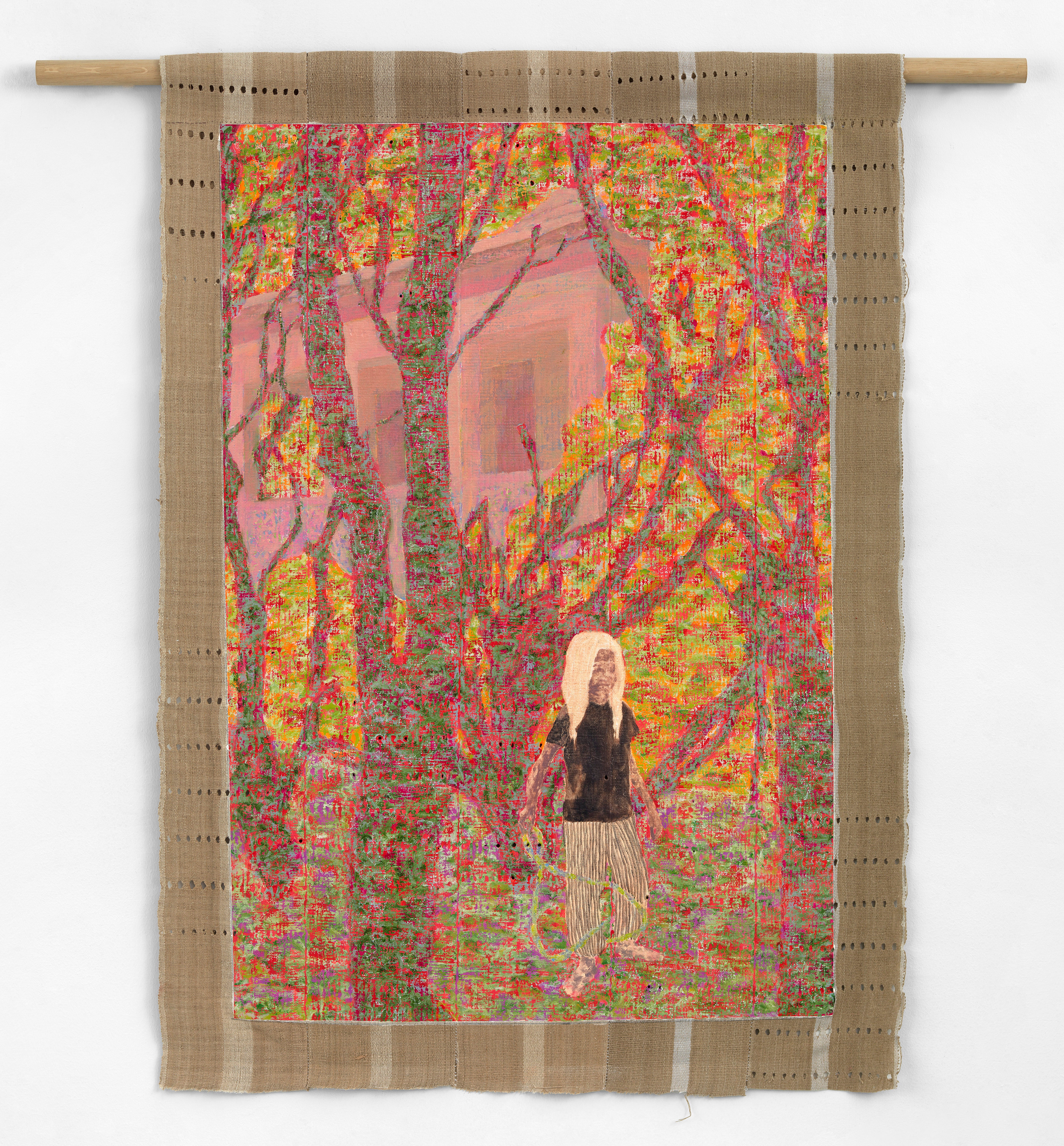
It’s not every day that an artist paints on art. In Nengi Omuku’s latest show, her canvas is sanyan, a precious handwoven textile used by the Yoruba people in West Africa. Traditionally worn for special occasions and ceremonies, sanyan is painstakingly crafted and long-lasting, and Omuku paints its surface in quick, pointillist brushstrokes. Her otherworldly paintings are crowded with people who walk through blurred greenery and sun-tinged clouds or seem to ascend into a realm beyond, their bodies disappearing into panoramas of colour.
The natural world and our place in it has been an enduring focus for Omuku, who trained under her mother as a horticulturist and florist. She grew up in Lagos, before moving to the UK as a teenager, studying at the Slade, and then returning to Nigeria. She now lives between Lagos and London.
This relationship to international city life informs her work’s grappling with green spaces that exist precariously in ever-expanding urban worlds. In one, a brutalist apartment building looms over a young girl walking through criss-crossing trees. In another, faceless people queue for fuel amongst foliage.
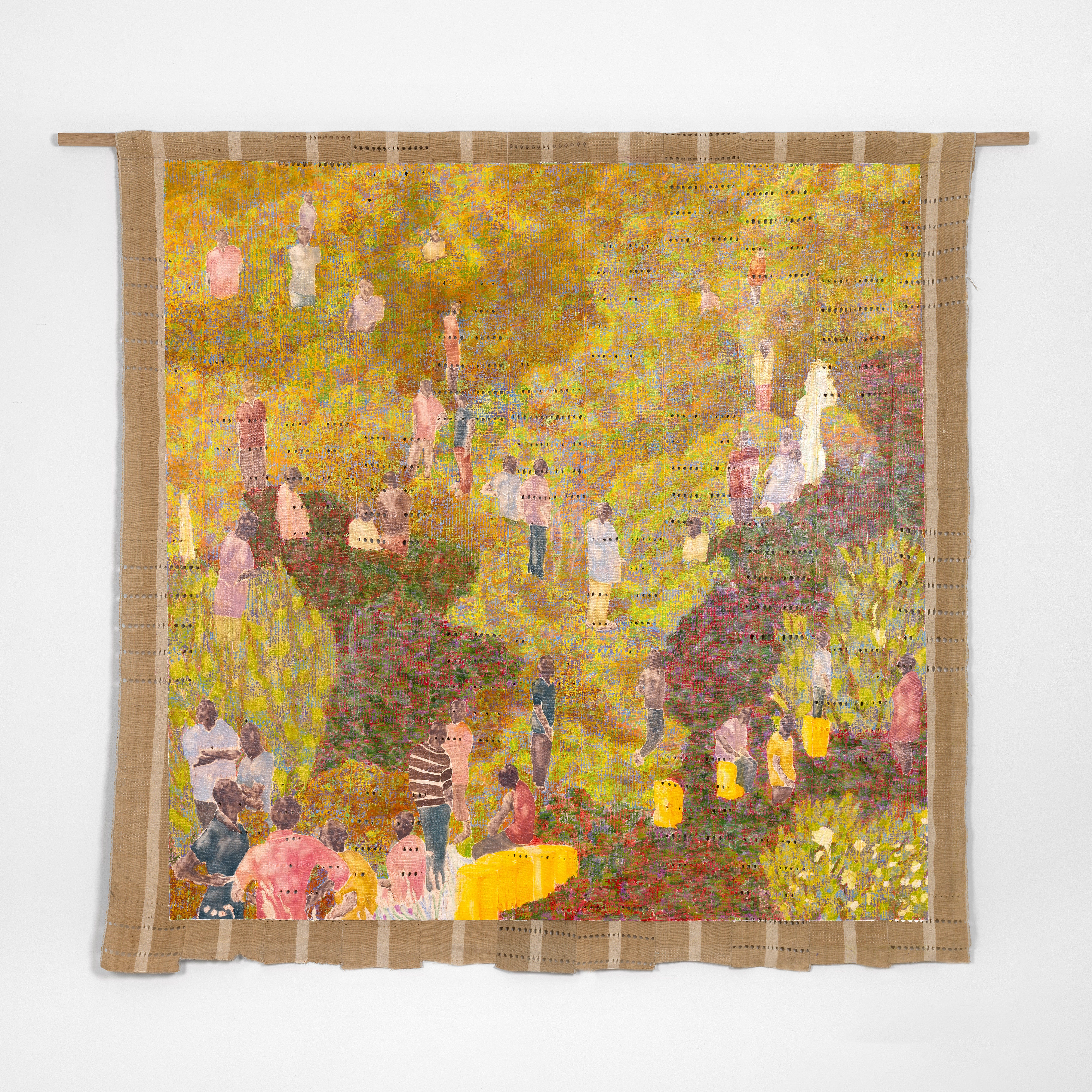
Think of gardens and you may think of paradise, places of solace, healing, growth. But since the days of Eden, these paradises has also been shaped by contradictions. They’re full of abundance, yet are equally linked to ownership and exclusion: who cultivates them, who gets to enjoy them, who is pushed out.
But this show is suffused by the dreaming of its title and, while acknowledging the political weight of this subject, Omuku sustains an uplifting sense of hope and possibility throughout. She reminds us that public gardens are a necessity, because creating them means creating sanctuaries where we can imagine, rest, connect – and dream.
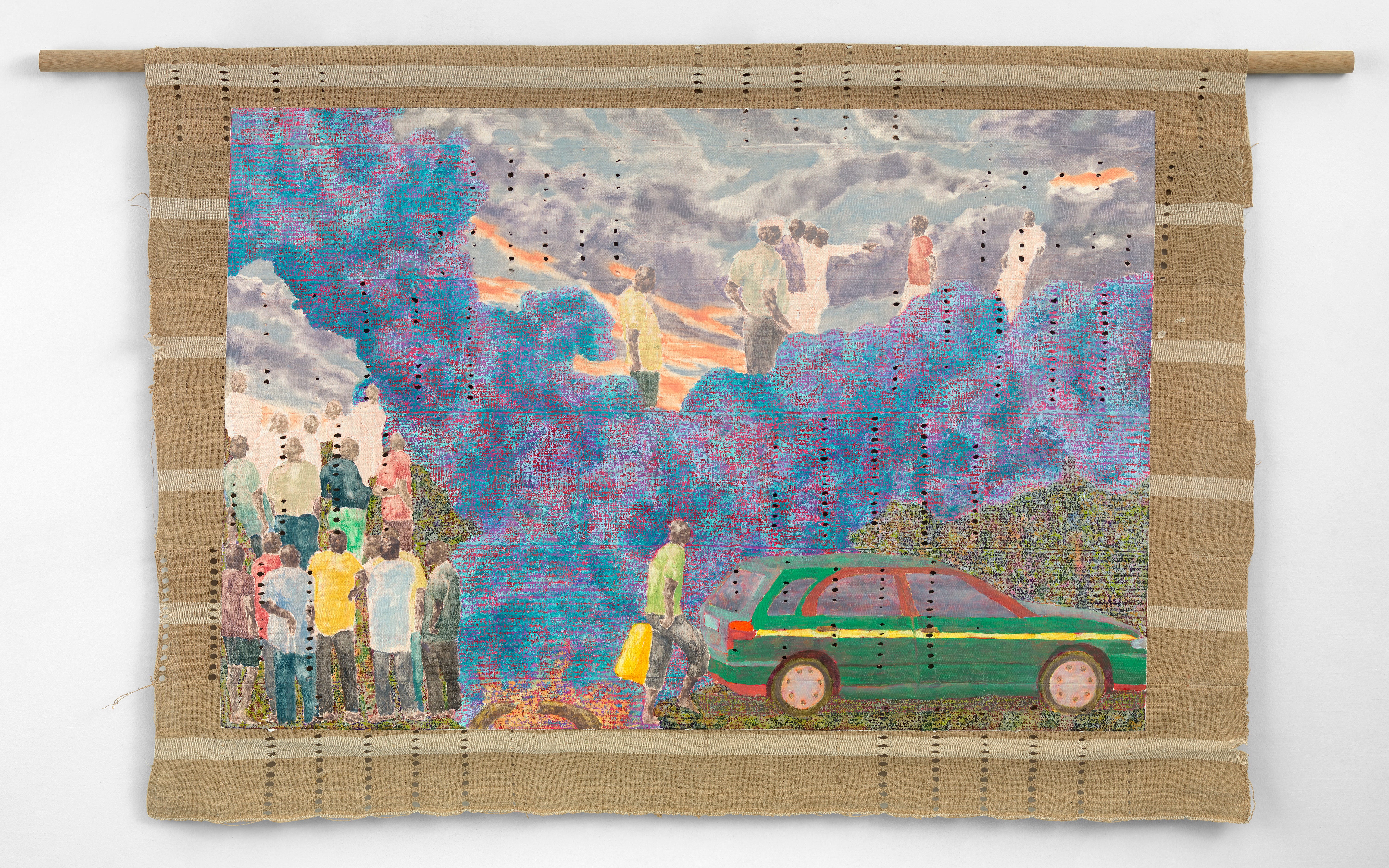
In the final painting, a man walks to his car, behind which billows an ambiguous cloud; is it rain or pollution? Yet in the background people stand, or float, gazing and pointing out to the horizon, towards different dreams, different possibilities, different futures.